

David Berry is the founder of Broquet, a floral company built around one bright bold idea: flowers made for men. His arrangements are designed to be noticed. They’re engineered to celebrate the men in our lives in full color, and to give them permission to be honored out loud. Broquet has already earned national attention, including a feature on the TODAY Show as a Father’s Day Gift Pick! Order a Broquet at gobroquet.com, and follow on Instagram at @gobroquet.
DC: What is your favorite color, and why?
DB: It’s impossible to pick, but I’d say blue most of the time and red the rest of the time. Blue takes me back to my childhood. It’s comforting. And when I imagine why the color has been so comforting, I can almost feel myself awash in the moments in my life where blue was present; my childhood bedroom, sky blue to evoke the “air” of the “Air Jordan” moniker. Every wall was sky blue, and the rest of it was adorned in posters of Michael Jordan. Now as an adult, blue represents the ocean, which I try to ride my bike along at least twice a week. It keeps me sane.
Red is a favorite when I’m really honest with myself. I always felt red was a cliche, evoking the image of a jerk in a sports car. But who put that idea in my head? Maybe stereotypes, but I allowed it to stay. Red is bold, and it is assertive, and it’s also eye-stopping — there’s a reason the red sports car gets noticed. The truth is I love red and what it evokes, and maybe I’m a bit scared to embrace that even though I think of myself as humble and mild-mannered. In reality, parts of me want to be bold and assertive, and I think red, in certain contexts, reminds me of that.
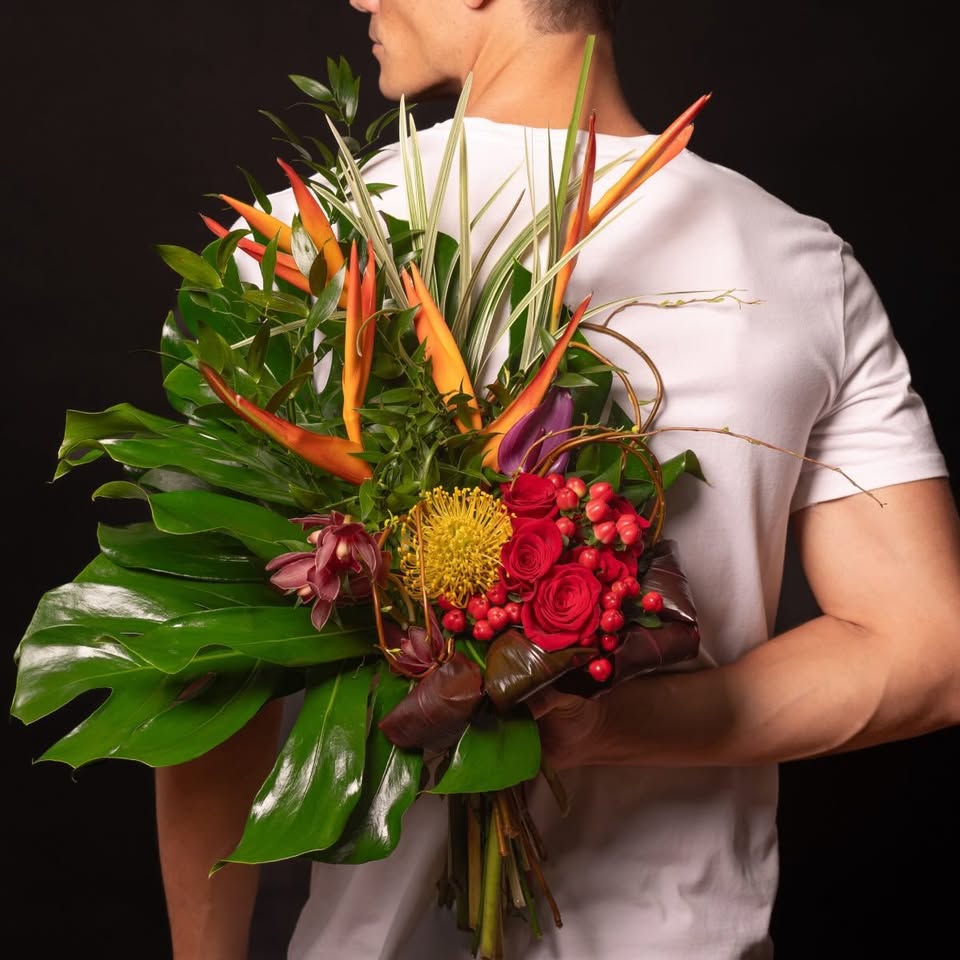
DC: I love the concept of Broquet! Where did the idea come from?
DB: I was six-years-old when Super Mario Bros. 3 came out. I wasn’t the type of kid who got the new video game when it was released, but I came home from school one day to find the game in its new packaging on my nightstand, and next to it was a single yellow carnation in a tall, slender vase. A few years ago, I thought about that carnation; Mom gave it to me. It was the first time I got flowers, and even as a young boy, it stuck with me, the feeling of getting something that’s rarely set aside for men and boys.
Around that time, I had also started noticing a cultural turn of phrase in hip hop and sports; “give him his flowers.” It was being used as a metaphor, of course, to celebrate a man for his achievements. But no one was actually giving men flowers. In a broader context, I started becoming aware of and sensitive to the emerging statistics about young men and boys. They are opting out of the social contract, pulling back from their education, and most troubling, men account for roughly three of every four “deaths of despair.” There are roughly 40,000 male suicides each year in the U.S., on the scale of women’s breast cancer deaths.
The seed for Broquet was planted in my childhood bedroom with that carnation, but it began to bloom in this context. I’m not so naive to think that a bouquet of flowers can flip that script, but I believe it’s a symbol of the type of love and acknowledgement that I think many men and boys are privately, and often publicly, hoping for. Flowers as a gift, in my opinion, can make anyone feel seen. Even men.
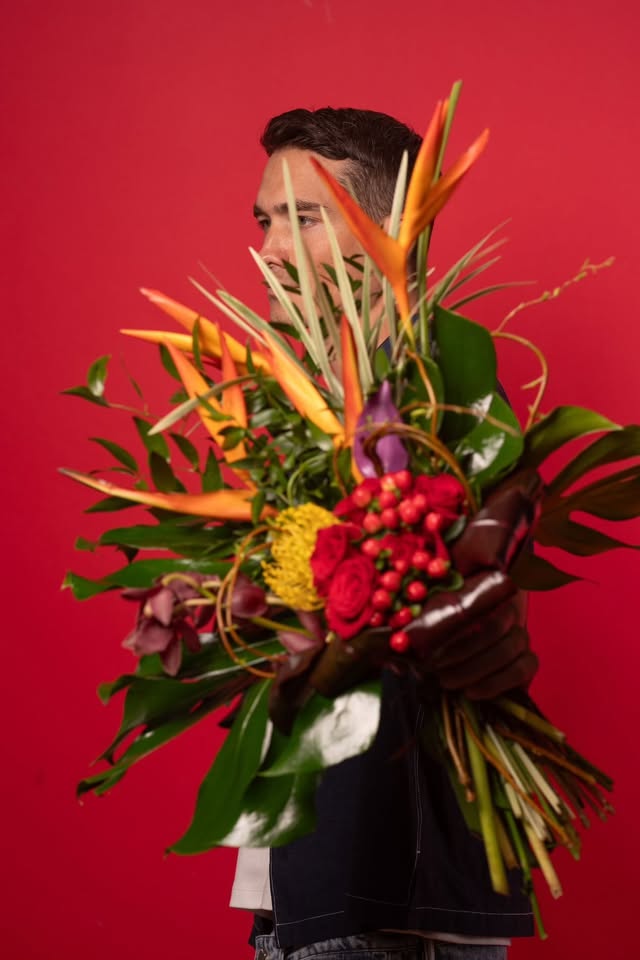
DC: Historically, flowers have had their own language based on color. How did you choose the arrangement colors, and what do they mean?
DB: Our debut bouquet – the Broquet, the eponymous one – was something I approached with great intentionality. Color played a massive role, but so did structure. It was important to me that the experience of getting a Broquet still felt intentionally masculine. The dark green of the Monstera leaves, for example, was intended to serve as a literal and metaphorical backbone to the bouquet. That deep green evokes confidence. Symbolism and bold color options played a role in the selection of Protea, as well; it symbolizes transformation and courage, and its mythological namesake embodied the ability to survive in harsh environments. The symbolism of Anthurium is abundance and love. Red Roses have the classic romantic, deep emotional association.
All of these stems, and the meaning of the colors, were intentional. Masculinity doesn’t fit inside the constraints of a tidy definition. It’s a lot of things, strength and softness. So, I felt it was important to strike a balance between two extremes that are often seen as mutually exclusive, and to proclaim plainly that they are not. And if the notion of a bouquet of flowers for a man didn’t make our vision clear enough, the stems we chose to include in the Broquet certainly should.
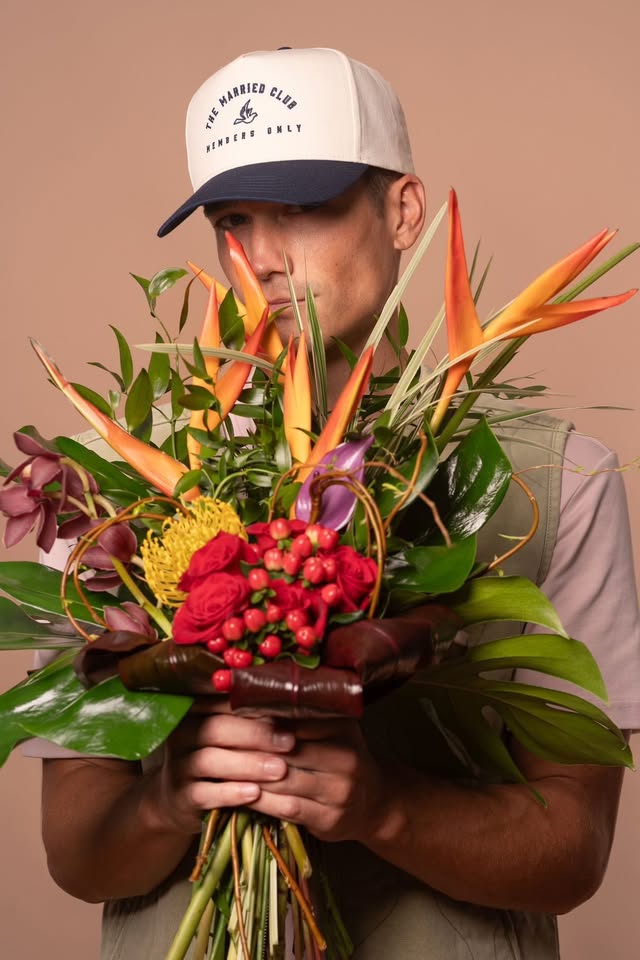
DC: What is the Broquet sender saying on Father’s Day?
DB: They say “I see you.” I think it’s easy for dads to anchor their self-worth to what they can provide and what they sacrifice for the ones they love, and I believe a Broquet is a symbol of acknowledgment. When you feel your value lies in providing for others, it’s easy to overlook your own needs for love and support. But I have seen the look on the faces of men who’ve received a Broquet, and even they find themselves caught off guard by how meaningful the gesture is. Men know the meaning of gifting flowers, which is why they fall back on it as a reliable, can’t-miss gift. To have it turned back to them is a plot twist most never saw coming, and I suspect it’s a feeling they will remember long after the stems have reached their end.