
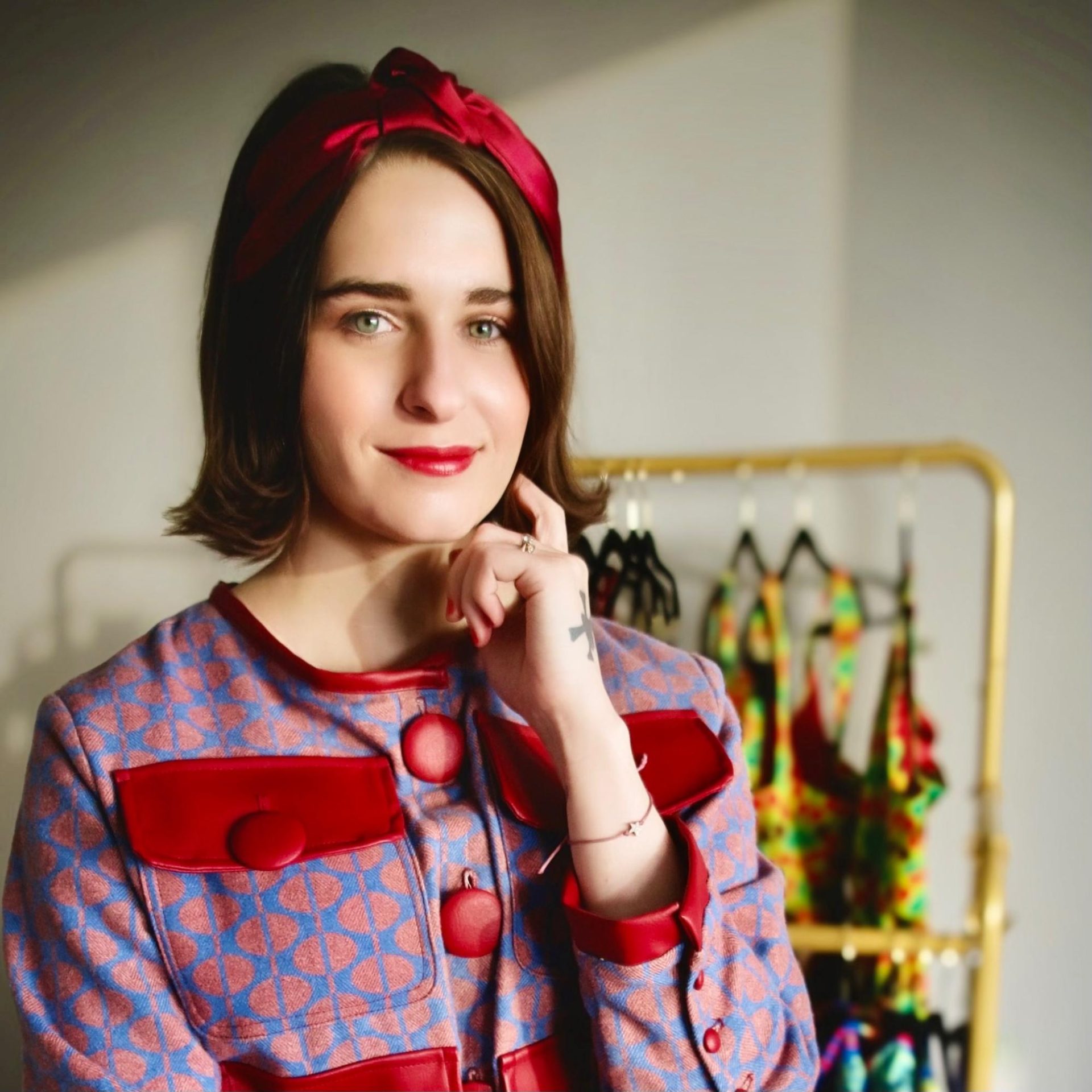
Kaylie Caswell, founder of House of Caswell, is a designer, musician, and visual artist whose work bridges artful modernism and nostalgic modernity through clothing, print, and sound.
Her design journey began in music, as the bassist of the genre-defying band Berried Alive, which she plays in with her husband. What started as a passion project designing band merchandise evolved into a full-fledged lifestyle and streetwear brand, marking her professional start in fashion.
Launched in 2025, House of Caswell can be found at houseofcaswell.com.
DC: What is your favorite color and why?
KC: My favorite color is purple.
Interestingly, it’s something I share with my three older sisters. We’re extremely close even though I live in Washington State and they live in Minnesota, and over time purple has taken on an added layer of meaning. We lost our dad to pancreatic cancer when I was in high school, and purple is the awareness color. Now, in our Sisters group chat, we all end our messages with purple hearts. It’s become both a shared language and a symbol of our connection.
But my love of purple actually started long before that. I’ve always been drawn to it for its emotional range. It can shift from warm to cool, from deep and saturated to barely there. Every version feels so rich and compelling in its own way. There’s something inherently dreamy about it, but also soothing.
My favorite variation is lavender, specifically a soft pastel tone. I’m very drawn to pastels in general. Even though they’re light, they don’t feel empty to me. They feel rich, almost creamy, like the color has a kind of roundness you can hold.
That’s what led me to choose a lavender tone as House of Caswell’s signature color. The specific Pantone shade is called Lavendula, which I love. Color names have always felt meaningful to me. As a child, whenever I got a new set of crayons or markers, I wouldn’t start by drawing or coloring, I would write down the name of every single color first. I kept notebooks filled with color lists. It became a kind of ritual.
I also used to go through magazines and catalogs and write down every color name I could find. My mom and I would play a game in the car where I’d read color names out loud as she drove, and we’d decide which name sounded the most beautiful. Then I’d show her the actual colors and we’d decide which color option was visually the most beautiful.
So choosing Lavendula wasn’t just about the color itself. It was about everything I’ve always loved about color, the way it can be named, remembered, and felt all at once.
As a history nerd, I’m also deeply drawn to the story of purple. It’s a color that has always carried weight. From Tyrian purple, which was derived from sea snails in ancient times, to Perkin’s mauve, the first synthetic dye, it has this fascinating story. Something so beautiful coming from something so unexpected.
That contrast feels very true to how I experience color in general. It’s never just visual. It’s emotional, historical, poetic, and personal all at once.
DC: Would you describe the connection between Berried Alive and House of Caswell?
KC: Berried Alive was what first made me believe I could do this.
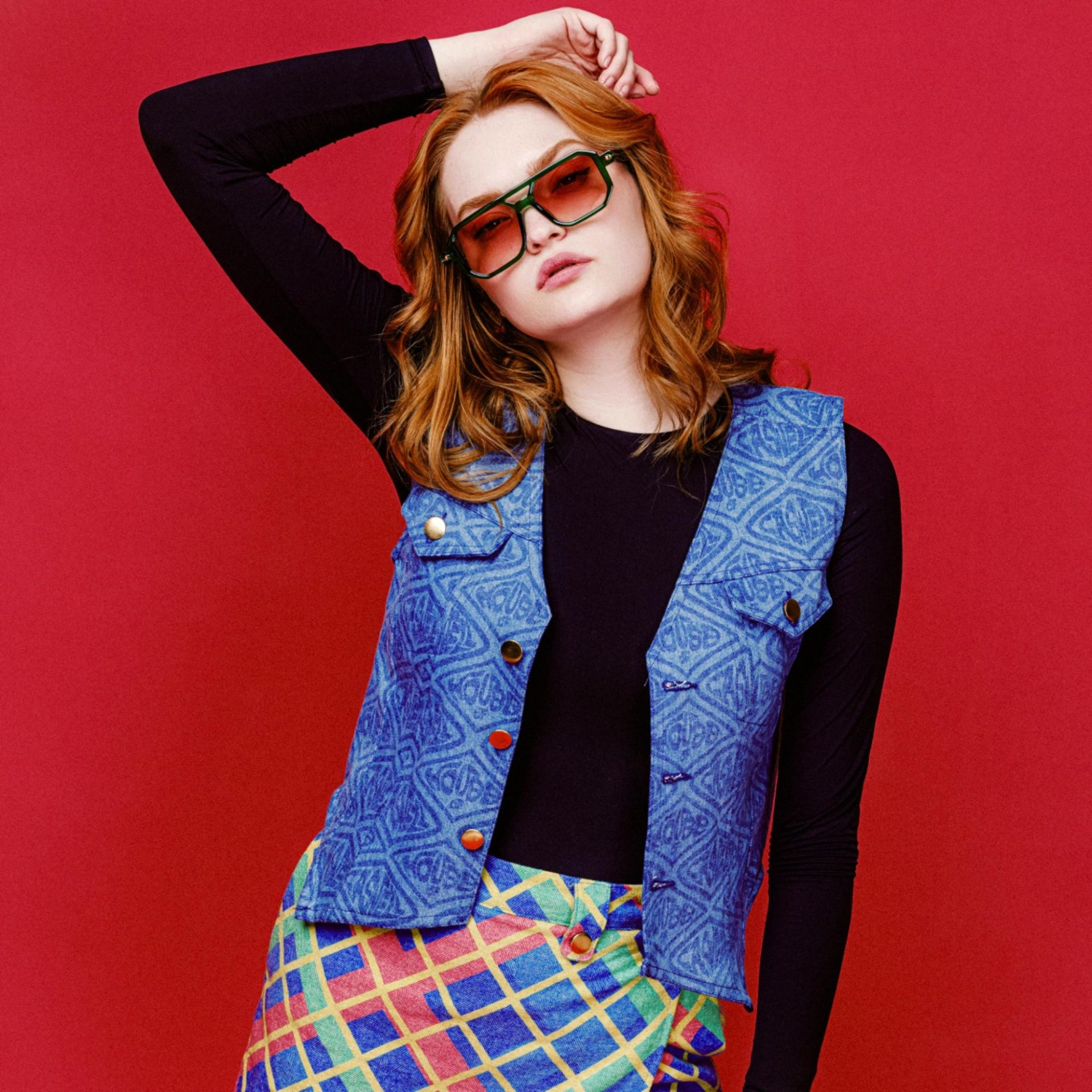
I’ve been designing clothing for Berried Alive for almost a decade, and what started as band merch slowly became something much more expansive to me, evolving into a full streetwear world built around each musical release, where we would begin with a song or an album and then translate that sound into a visual language, either through artwork I created digitally or through collaborations with other artists, and from there I would design an entire collection around that single image, either using it in its entirety or taking motifs out to create repeating patterns.
In that way, House of Caswell didn’t feel like a departure so much as a continuation, just taken further.
The Still Life collection actually began as a song I wrote years ago about life feeling stagnant, about being caught in repetition (an actual still life), and at the time I had no idea that it would extend beyond music. But when it came time to create the single artwork, I realized I wanted to do something more literal and analog, so I started taking pastel classes and spent about a year studying and building my skills before I felt ready to create the image that the song deserved. That painting ended up becoming the foundation for everything that followed.
What began as a single pastel piece slowly unfolded into something much larger, as I started translating the artwork into repeating patterns, then into garments, and eventually into a full collection, so the process remained rooted in the same structure I had been using in Berried Alive, but expanded across mediums in a more permanent and immersive way.
That idea of translating a single idea from one medium to another is really the core connection between the two.
Even in music, when I’m writing basslines for Berried Alive, I approach it almost like painting, thinking of the notes within a key as a palette, like a set of colors or swatches, where staying within that palette creates cohesion, and then introducing an unexpected note, like a sharp or a flat, feels like adding an accent color, something that creates tension and draws your attention.
That way of thinking has carried across everything I do, whether I’m working in sound, in painting, or in clothing, because it always comes back to the same idea, that you’re building something from a limited set of elements, and the meaning comes from how you choose to arrange them, layer them, and occasionally disrupt them.
DC: Your approach to color is unique – are you color styling by collection or individual pieces?
KC: When I’m designing a collection, I always begin with a very limited color palette.
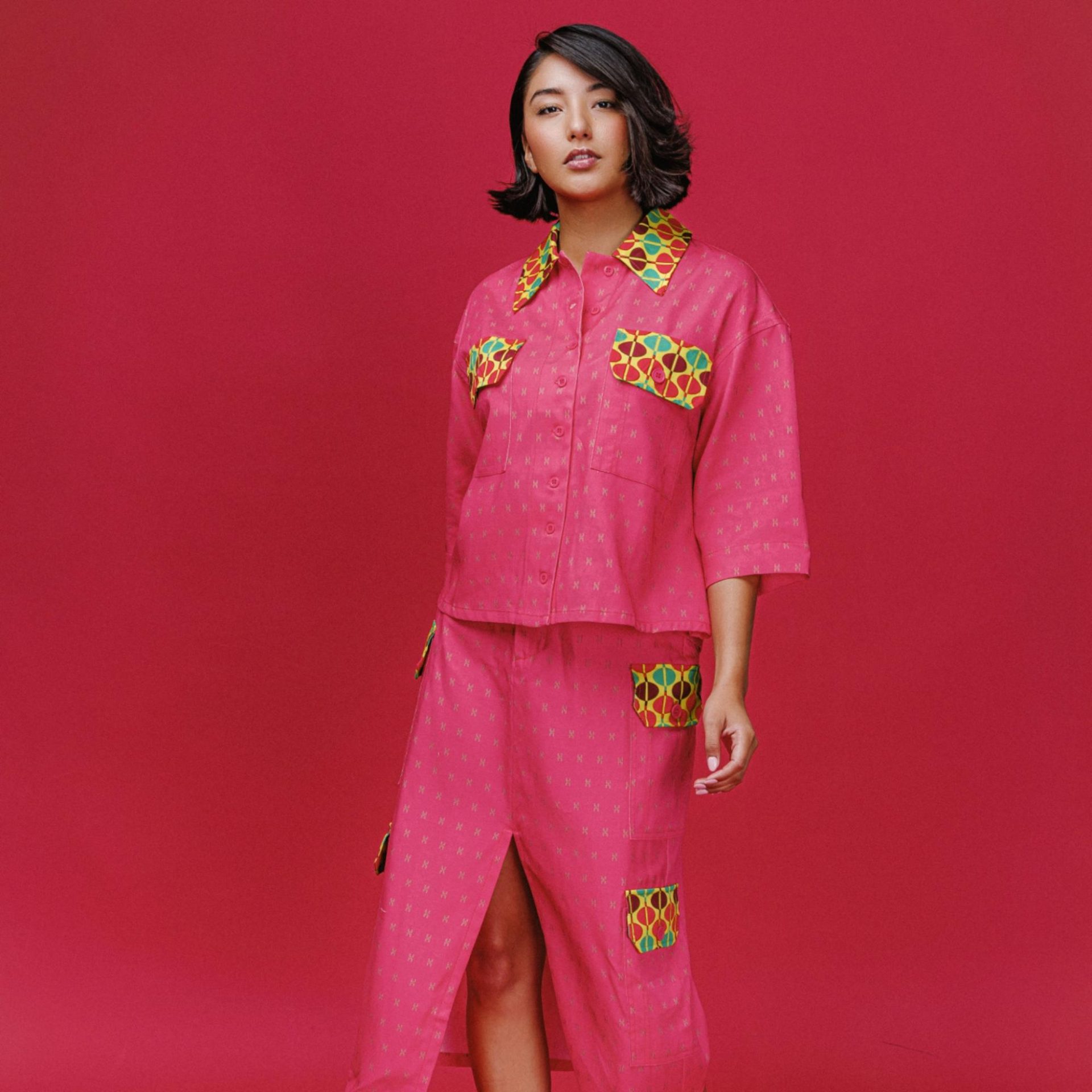
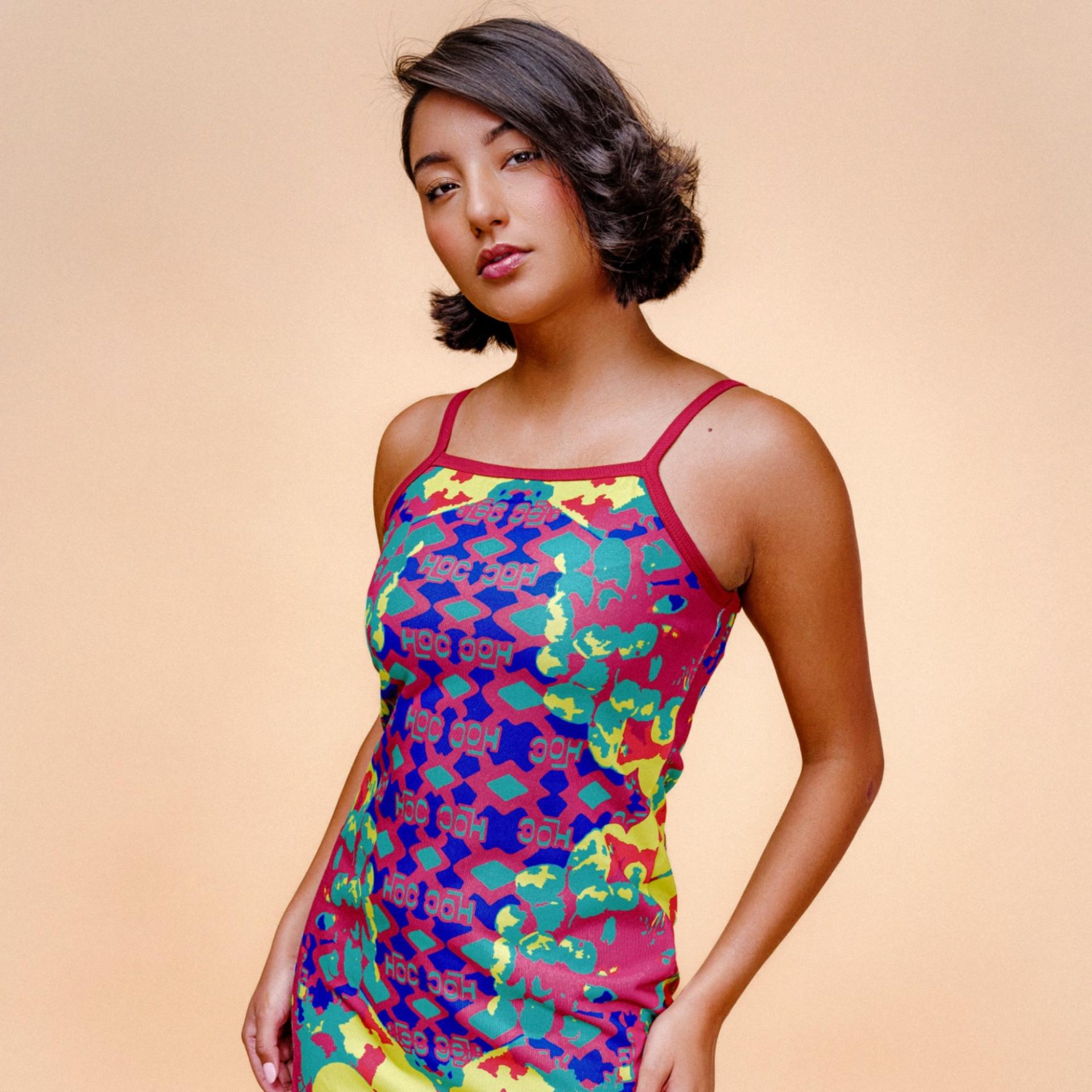
For Still Life, the entire collection stems from an eight-color palette, but that palette didn’t come from trend forecasting or external references, it came directly from the emotional atmosphere of the original pastel painting. That artwork wasn’t just the visual origin of the collection, it was the emotional origin, and the colors held the story long before patterns or silhouettes existed.
To understand that color story more clearly, I broke the painting apart digitally and began experimenting with how it translated through different reductions, and with each version, something new would reveal itself. When I reduced the painting down to eight colors and pushed their saturation slightly higher, everything came into focus, and it didn’t feel like loss, it felt like distillation, like the emotional core of the artwork had made itself clear.
Those eight colors became the backbone of the entire collection: blues that ground the world, reds that add depth, a balancing green, and a single cool yellow, Pantone Lime Punch, used sparingly for an unexpected pop of whimsy.
From there, I used those same eight colors to build every repeating pattern across the collection, and even when selecting solid fabrics from available swatches, I tried to stay as close as possible to that original palette.
I’ve followed a similar process with my second collection, which is based on a pastel painting I created of my parents on their wedding day in 1973, where I intentionally limited the palette from the very beginning, working mostly with soft ’70s tones like earthy greens, peaches, and a baby blue, all slightly disrupted by a deeper plum-brown taken from my dad’s tux.
So when I began translating that painting into patterns, I stayed entirely within that palette again, allowing the colors themselves to carry the continuity of the collection.
In that sense, I’m always color styling at the level of the collection first, because the palette becomes the world everything exists within, and then within that world, each piece finds its place, sometimes harmonizing, sometimes introducing a small amount of tension, but always speaking the same language.
Going forward, that’s the foundation of how I plan to work, beginning with an artwork, whether my own or eventually in collaboration with other artists, distilling it down to its core colors, and then building an entire collection from that palette so that everything feels interconnected, like different expressions of the same idea.
DC: How do you define longevity in music, art, and design?
KC: I think longevity has less to do with how long something physically lasts and more to do with whether it continues to hold meaning over time.
In music, my husband Charlie and I have noticed something really interesting with Berried Alive, where listeners will often feel deeply nostalgic for a specific era or album and say things like, “why don’t you make songs like this anymore,” even when, from our perspective, we are still writing in a very similar way. What they’re responding to isn’t just the structure of the music itself, it’s the version of themselves that existed when they first heard it, the way that music became tied to a specific period of their life, and when they return to it, they’re not just hearing the song, they’re re-entering a feeling.
That’s something you can’t fully control as an artist, but you can create the conditions for it by making work that is rooted in shared human experience rather than something overly specific, because while our circumstances are all different, the emotional range we move through is largely the same, and when a piece of art reflects that back to you, it has the ability to stay with you.
I think clothing functions in a very similar way, even though it’s often treated as something more surface-level.
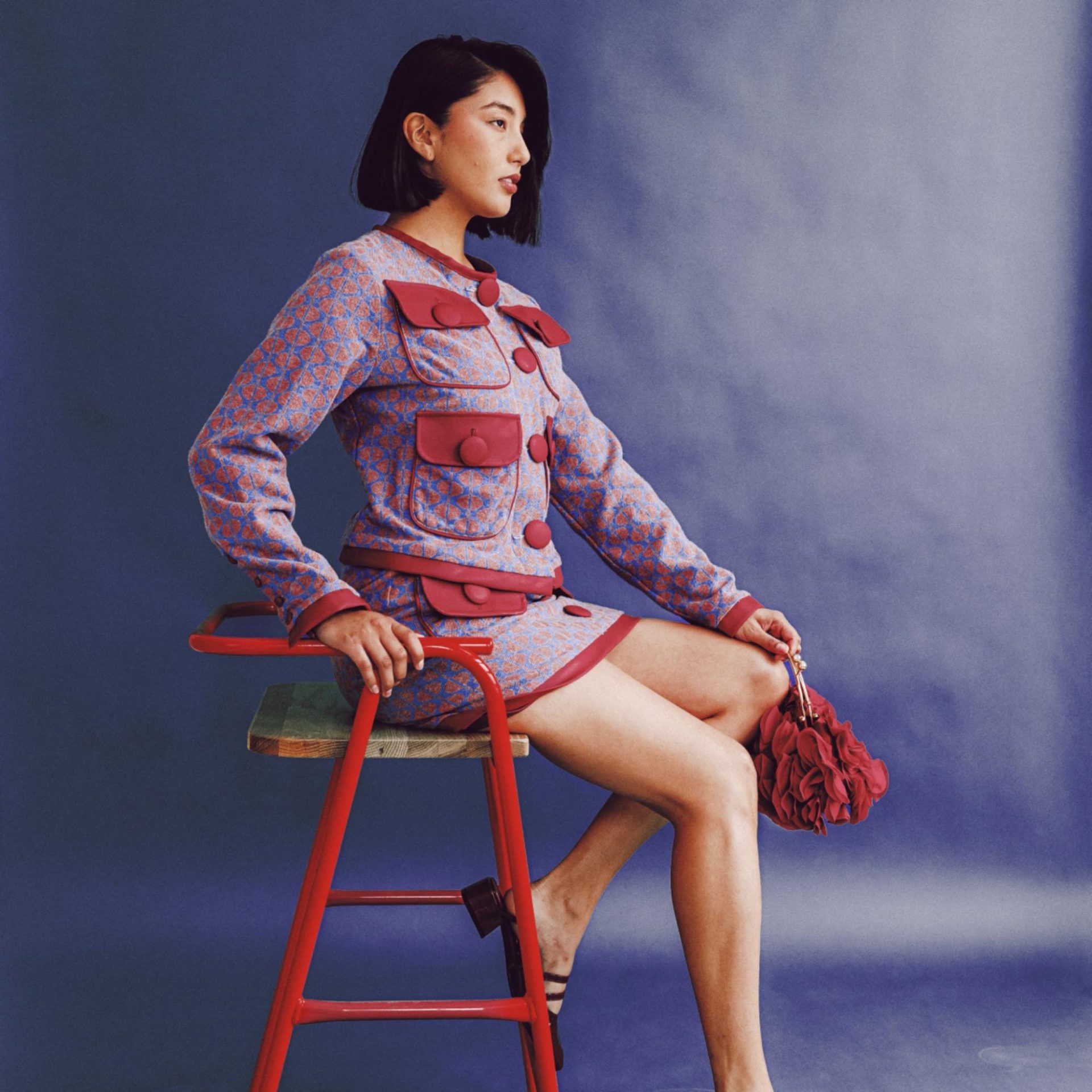
To me, clothing is deeply tied to memory. I can recall entire moments in my life through what I was wearing, not just the event itself, but the feeling, the version of myself I inhabited at the time, the sense of confidence or uncertainty, the atmosphere of that moment. A garment can return all of that at once, way more precisely than memory alone. At least for me, anyway.
Because of that, I don’t think longevity in fashion comes from creating something completely new or unfamiliar. There’s often this idea that fashion is only art if it’s entirely avant-garde, something never seen before, but I actually feel the opposite. Clothing has been part of the human experience for at least tens of thousands of years, and in many ways, to be human is to wear clothing. So familiarity is not a limitation, it’s part of what allows us to connect to it.
When something feels wearable, recognizable, and emotionally grounded, it has the potential to become part of someone’s life, and that’s where longevity begins.
So for me, across music, art, and design, longevity comes from emotional attachment, from creating something that can be lived with, returned to, and reinterpreted over time, something that doesn’t just exist in a single moment, but continues to gather meaning as a person moves through their life.
DC: Please share your philosophy of authenticity and ownership.
KC: I don’t think authenticity necessarily means creating something from nothing.
To me, authenticity comes from how something feels, whether it resonates, whether it holds emotional truth, and I think that often comes through transformation rather than invention. I’ve always thought about this in terms of remixing, almost the way a DJ works, where you’re not inventing entirely new sounds, but you’re taking existing ones, recontextualizing them, layering them, and allowing something new to emerge through the combination.
We use samples in Berried Alive all the time. They help set a mood and create an atmosphere, and that doesn’t make the music any less ours. If anything, it makes it more expressive.
I also think authenticity applies to the self in the same way.
I don’t believe you have to remain the same version of yourself in order to be authentic. For most of my life, I’ve moved through different versions of myself visually, creatively, and personally, and I’ve come to see that as part of the process rather than a lack of clarity. You’re allowed to try things on, to follow what feels right in a particular moment, and to evolve as your perspective changes.
In that sense, authenticity isn’t about staying fixed, it’s about allowing yourself to change while still recognizing that all of those versions belong to you.
Ownership, for me, comes from being able to trace something back to its source, and knowing that source is yours, even if you did remix inspirations from other places.
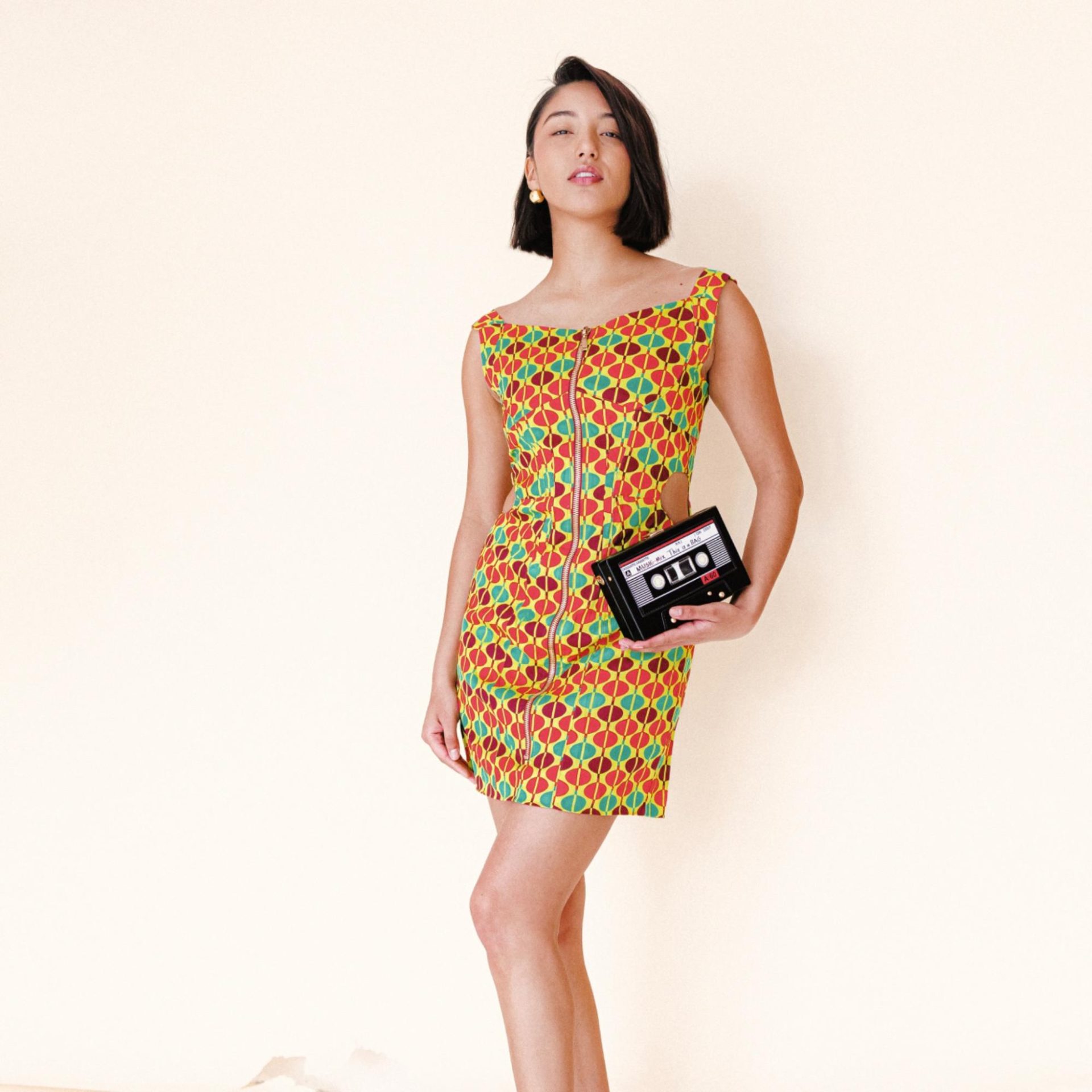
In my own practice, my work exists across sound, image, and worn objects, and often begins with something I’ve created myself, whether that’s a song, a painting, or a piece of writing, and then moves through different forms. The garments I design are derived directly from my own artwork, so they don’t feel like separate objects, they feel like extensions, more like editions of an original piece translated into something that can be worn and lived in.
Because of that, the work carries a kind of internal continuity, where even as it changes form, it still belongs to the same origin.
DC: Where do you find color in your life?
KC: I seek out color everywhere.
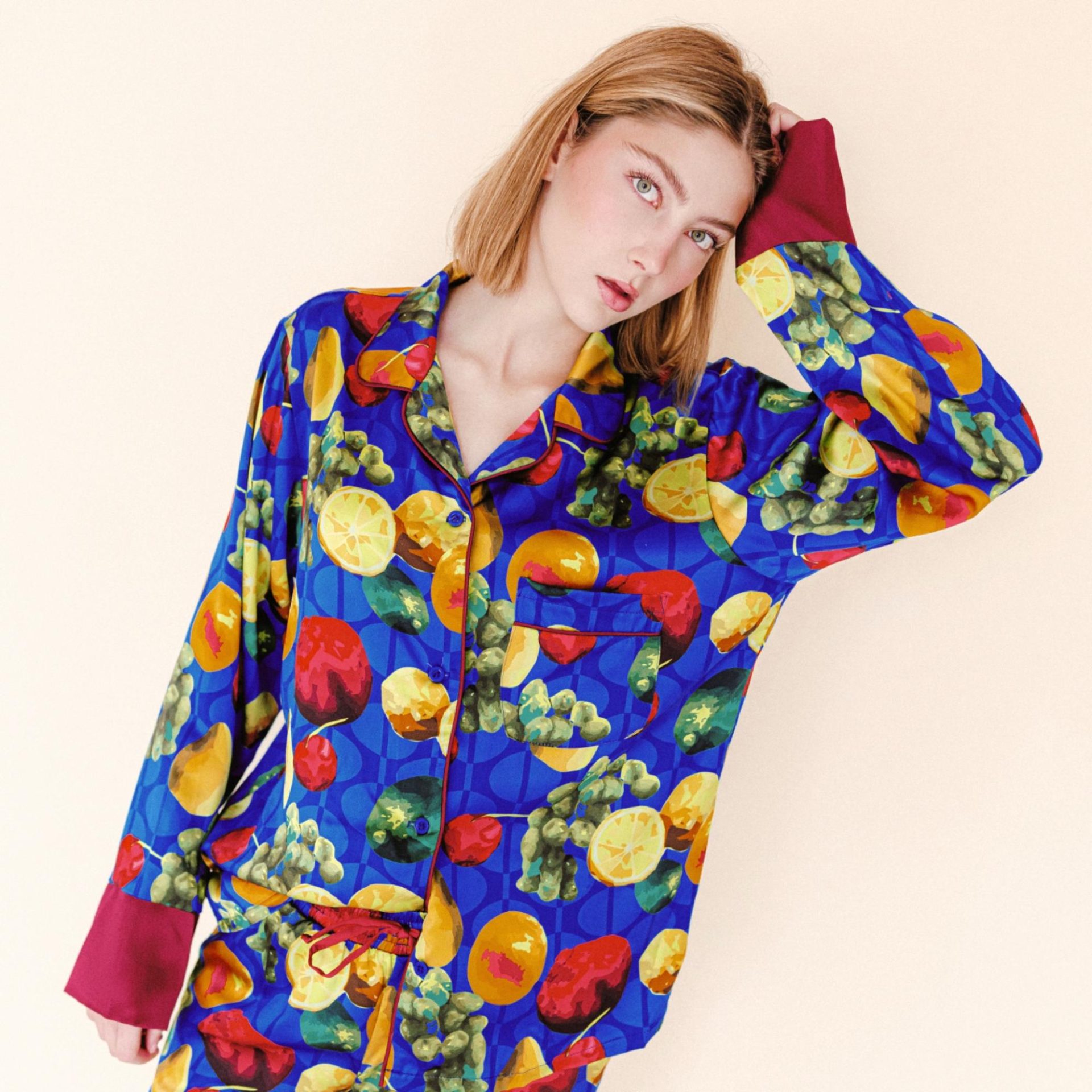
Long before House of Caswell, color had already shaped how I understood myself. Charlie and I have spent years creating clothing for Berried Alive using, quite literally, every crayon in the box, and that has always been intentional. Many fans come to the band through a traditional metal or goth background, where black dominates and seriousness is often equated with restraint, but that was never us.
We aren’t goth, and we aren’t even really metalheads in the cultural sense. We play technical, guitar-oriented music that often gets categorized as metal because it doesn’t fit neatly anywhere else, but the music itself is extremely colorful, constantly moving across genres, moods, and emotional registers. So a monochrome visual world never felt honest.
The clothing had to reflect that. The bright, often neon colors aren’t meant to shock, they’re meant to align the sound with the image. And for many fans arriving from darker palettes, I think those colors have become a kind of release, a reminder that intensity doesn’t require the absence of color.
Because of that, I’ve spent years quite literally living in color. Much of my personal wardrobe comes from Berried Alive samples, so my day-to-day life is surrounded by it, and it genuinely affects how I feel. Color makes the complexion vibrate. For example, I’ve always felt that all people look good in pink. It reflects a healthy, rosy tone on absolutely everyone and I’ve never seen someone look bad in pink.
At the same time, I’ve trained myself to see color more closely.
I still take pastel painting classes once a week with Barbara Sheehan, who is an incredible artist, and through that practice, I’ve learned to see color in a completely different way. When I look at a person now, I don’t just see skin tone, I see undertones, greens, yellows, blues, purples, reds, and I notice how shadows shift those colors rather than simply darken them.
I’m constantly comparing one color to another, noticing how they vibrate when placed side by side, how one can intensify or soften the other depending on context.
At this point, I don’t really feel like I “find” color as much as I live inside it. My husband would probably tell you that one of my greatest joys in life is when I find two completely unrelated objects that match perfectly in color. It makes me unreasonably happy.
DC: If you were giving a TED-Talk about your life, what advice would you give?
KC: I think the most important thing I’ve learned is that you don’t need to have a fully formed plan, you just need to follow an idea far enough to see what it wants to become.
My path hasn’t been linear, but when I look back, it feels surprisingly continuous. I’ve moved through different fields, music, art, writing, and other areas of study and work, but the same instincts have always been there underneath, even when I didn’t fully recognize them at the time.
A lot of what I do now, I was already practicing in some form when I was younger, just without the language for it. Drawing outfits, imagining who would wear them, building small worlds around them. At the time it felt like play, but it was actually a way of learning how to think, how to follow an idea without needing to know where it would end.
I think that’s something I’ve come to trust more over time, that the things you’re naturally drawn to, especially the ones that keep reappearing in different forms, are usually pointing you somewhere, even if you don’t understand how yet.
At the same time, I don’t think you have to be the same version of yourself all the time.
For most of my life, I’ve moved through different versions of myself, different aesthetics, different ways of expressing who I am. And I think that, to some people, this may look like I haven’t figured myself out yet. But I’ve come to understand that those shifts are not contradictions, they’re part of the process. You’re allowed to try things on, to step into a version of yourself that feels right in a particular moment, and then move again when something else feels more true. You don’t have to like the same things forever to still be yourself.
In a way, that is authenticity to me, not staying fixed, but allowing yourself to evolve while still recognizing that all of those versions belong to you .
The same thing has happened across my work. A song becomes a painting, a painting becomes a collection, an image or idea returns years later in a completely new context. None of it was planned that way, it only becomes clear in hindsight.
So if I were giving a talk, I don’t think my advice would be to map everything out or try to arrive at a final version of yourself. It would be to stay close to your instincts, to pay attention to what keeps pulling you back, and to give yourself the space to follow those ideas, and those versions of yourself, as they evolve.
Because sometimes what feels like change is actually continuity.